
· by Michael Blair, Nashville's Chimney Sweep
Spring and fall evenings in Middle Tennessee are made for sitting outside, and a fire keeps people out there once the air turns cool. Where it goes and how it’s built decide whether it gets used or becomes an ornament. We build them through our outdoor fireplace service, and the spot it stands on is the first thing we settle.
What matters most when placing an outdoor fire?
Distance comes before anything else. NFPA’s Educational Messages Desk Reference says to use a fire pit only outdoors and at least 10 feet from anything that can burn, and to keep it away from siding, decks and deck railings and out from under eaves and overhanging branches or structures. In plenty of backyards that crosses off the obvious spots: under the big oak, beside the deck stairs, beneath the pergola.
Then watch the smoke. We’d spend a few evenings noticing which way the breeze usually blows before anything is poured, and set the seating where the smoke drifts away from it. We’d also keep the fire close enough to the patio that lighting it takes no effort.
How is a fire pit different from an outdoor fireplace?
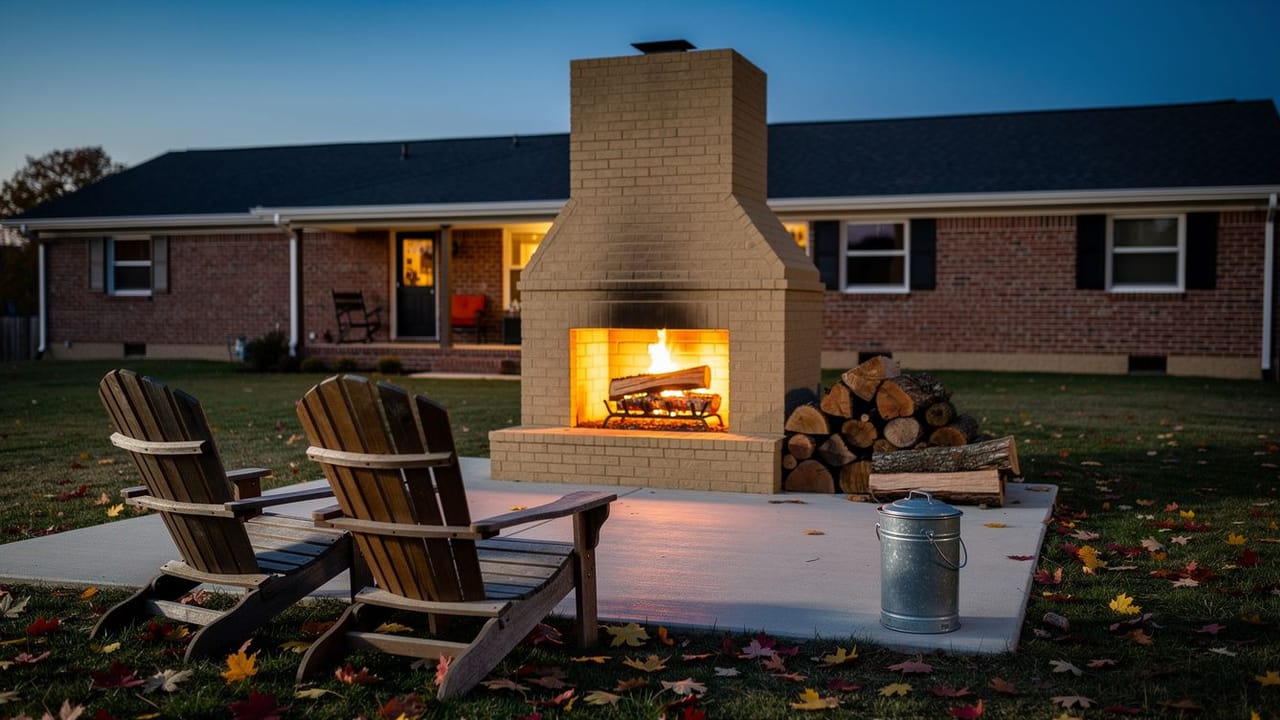
A fire pit is open on all sides, so people can sit all the way around it. A fireplace throws its heat forward, its back wall shelters the seating from wind on that side, and the chimney gives the patio a tall piece of masonry to arrange everything around.
A fireplace also carries smoke up a flue and lets it go above head height, where an open pit leaves it at seat level. A flue only does that when it draws, which is the same problem behind smoke coming into the room from an indoor fireplace, so we build an outdoor chimney for draft first and looks second.
- Keep at least 10 feet from anything that can burn, overhead included
- Watch where the evening breeze carries smoke before choosing the spot
- Settle gas or wood before the base is built
- Read your HOA covenants and ask the Fire Marshal’s Office about burn rules
- Set a fire pit on patio block, brick or concrete
Gas or wood
Gas starts at the turn of a valve and leaves no ash behind, though it needs a gas supply brought to it, which is easiest to plan before the patio goes in. NFPA’s one rule for a gas fire pit is to turn off the fuel source after use.
Wood gives you the crackling fire most people picture, along with a woodpile and ash to deal with. NFPA says to burn only clean, dry hardwood seasoned at least 6 months, never to start or relight the fire with lighter fluid or gasoline, and to put cooled ashes in a metal container with a tight-fitting lid used only for ashes, never straight into a trash can. Our post on firewood that won’t wreck your chimney covers how to tell when a split is dry enough. Some homeowners split the difference with a wood-burning firebox fitted with a gas starter to get the logs going.
Do Nashville’s burning rules allow a backyard fire?
Metro’s open burning rule, Section 10.56.250 of the Metropolitan Code, allows recreational fires of reasonable size and duration that contain no plastics, rubber or similar refuse, and fires for outdoor cooking in equipment or a fireplace designed for it. In 2013 Metro Council’s Ordinance BL2013-421 added “with a valid permit from the fire marshal” to the recreational-fire line, and it notes that the fire marshal decides when conditions allow open and recreational burning. Whether a backyard pit needs that permit is a question for the Nashville Fire Marshal’s Office, so call them before the first fire.
A permanent masonry fireplace is a building project. On Metro Codes’ list of building projects that may or may not require a permit, new brick fireplaces, new chimneys and new brickwork are marked as needing one for one- and two-family homes. Metro’s accessory structure permitting instructions say accessory structures cannot sit over platted setbacks, side street setbacks or utility easements, and whether Codes treats a freestanding fireplace as one is worth asking before the footing is dug. HOA covenants can add rules of their own on permanent structures, so read yours as well. When you have a spot in mind, ask us for a free estimate.
Sources
- NFPA, Educational Messages Desk Reference, 2026 edition (section 16.3, Fire Pit Safety) — 10 feet from anything that can burn; away from siding, decks, eaves and overhanging branches; level non-combustible base; seasoned hardwood, no lighter fluid; ash disposal in a lidded metal container; turn off gas after use
- Metropolitan Code of Nashville and Davidson County, Section 10.56.250 Open Burning (copy hosted by US EPA) — Recreational fires of reasonable size and duration, no plastics or rubber; outdoor cooking fires in equipment or a fireplace designed for it
- Metro Council, Ordinance BL2013-421 (approved June 6, 2013) — Adds a fire marshal permit to recreational fires under 10.56.250(A); fire marshal determines when conditions allow open and recreational burning
- Metro Codes and Building Safety, List of Building Projects Which May or May Not Require a Permit — New brick fireplaces, new chimneys and new brickwork require a permit for one- and two-family dwellings
- Metro Codes and Building Safety, Accessory Structure Permitting Instructions — Accessory structures cannot be over platted setbacks, side street setbacks or utility easements
FAQ
Outdoor Fireplaces and Fire Pits — questions
Do I need a permit for an outdoor fireplace in Nashville?
For a permanent masonry fireplace, plan on one. Metro Codes lists new brick fireplaces and new chimneys as needing a building permit for one- and two-family homes, and its accessory structure rules keep structures off platted setbacks and utility easements. For a fire pit, Metro Code allows recreational fires, and a 2013 ordinance added a fire marshal permit to that line, so call the Nashville Fire Marshal’s Office before assuming none is needed. HOA covenants can add their own rules.
How far should a fire pit be from the house?
NFPA’s guidance is at least 10 feet from anything that can burn, away from siding, decks and deck railings, and out from under eaves, overhanging branches or a pergola. Look up as well as across when you measure. After that, notice where the evening breeze sends the smoke and keep the seating out of its path.
Gas or wood for an outdoor fireplace?
Gas starts at the turn of a valve and leaves no ash, which suits a quick fire after dinner, but it needs a gas supply run to it. Wood gives the fire most people picture and needs dry, seasoned hardwood, somewhere to keep it, and a lidded metal can for cooled ashes. A wood-burning firebox with a gas starter is a middle path some homeowners choose.
How do you build an outdoor fireplace?
Placement comes first: at least 10 feet from anything that can burn, clear of eaves and branches, with the usual breeze carrying smoke away from the seating. Settle gas or wood before the patio goes in, since gas needs a supply line, build the chimney for draft first, and get the permit Metro Codes requires for new brick fireplaces.