
· by Michael Blair, Nashville's Chimney Sweep
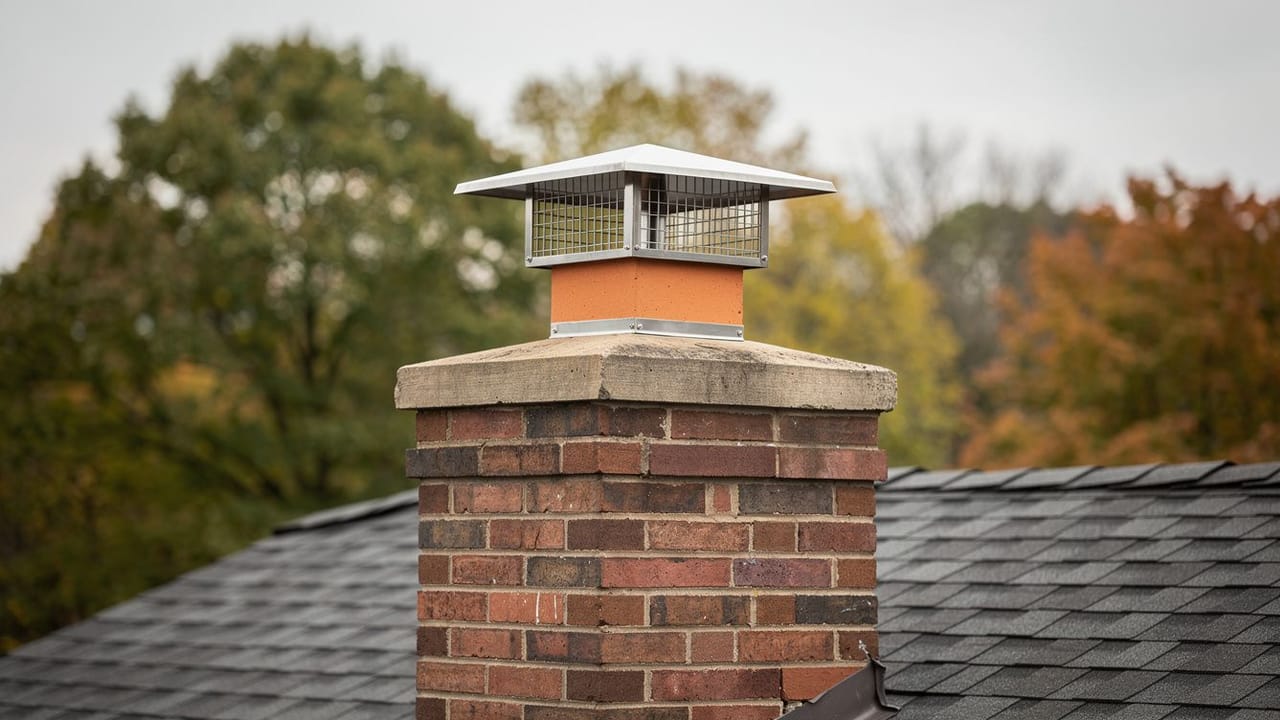
Ask for a chimney cap and you may get two different answers, because the word covers two parts. One is the metal hood with mesh sides that sits over the flue. The other is the slab of concrete or stone that seals the top of the masonry, which the code also calls a cap and most of the trade calls the crown. This post is about the first one: what it does, the kinds, the metal, the mesh rule, and how we size and fasten one. A missing or rusted-out hood is one of the cheapest things on a chimney to fix and one of the most expensive to leave, which is why it sits on our caps, crowns and flashing page next to the crown work it protects.
Four jobs on top of the flue
An open flue is a pipe pointed at the sky. Rain falls straight into it, and in a Nashville spring that is a lot of water running down the tile, into the smoke chamber and onto the damper. The Chimney Safety Institute of America puts the case plainly in its water damage recommendations: a well-designed cap keeps out rainwater and stops birds and animals from entering and nesting, and caps also work as spark arrestors.
The fourth job is wind. A hood over the outlet breaks the wind that blows across the top of the flue and can push smoke back down, which matters on a chimney that sits below a taller roof line or beside a big oak. A cap will not cure a chimney that is too short or a flue that is too small for the fireplace, but it takes away the gusty-day puffs of smoke that have nothing to do with either.
None of this replaces the crown. The 2018 International Residential Code, R1003.9.1 requires a masonry chimney to have a concrete, metal or stone cap with a drip edge, sloped to shed water, with a caulked bond break around the flue liners. That is the crown. The hood sits above it, and a hood bolted onto a crown that is cracking through only keeps the rain off the part of the chimney that was not the problem.
Single-flue, multi-flue and damper caps, and the metal
A single-flue cap fits over one clay flue tile that stands proud of the crown. It has a base that slips over the tile, mesh on four sides and a hood on top, and it is what most brick chimneys on ranch houses and older split-levels in Middle Tennessee take. A multi-flue cap is one large hood that covers two or more flues, or a tile that sits flush with the crown, and it mounts to the crown itself. We use it when a chimney carries a furnace or water heater flue beside the fireplace flue, or when the tiles are too short or too close together for separate caps.
A top-sealing damper cap combines the two parts a chimney most often has trouble with. It is a cap with a lid that closes against the top of the flue, worked by a cable down to the firebox, and it replaces a rusted or warped throat damper without tearing out the smoke chamber. When it is closed, the warm air in the house stays in the house instead of standing in a cold flue all winter.
For the metal, stainless steel is what we put on most chimneys. Galvanized steel costs less at the start, but the zinc coating wears through and the steel rusts, and rust streaks down the brick and the crown in our humid summers. Copper is chosen mostly for how it looks on a slate or standing-seam roof. Whatever the metal, the base, the hood and the mesh should all be the same one, because mixed metals at the fasteners are where corrosion starts.
The spark arrestor mesh and what the code asks of it
The mesh is what makes a cap a spark arrestor. It catches embers riding up on the draft so they burn out in the cap instead of landing on the shingles, the gutter full of leaves or the neighbor’s deck. The code does not require every chimney to have one. It sets the rules for one that is installed: the 2018 IRC, R1003.9.2 says that where a spark arrestor is installed on a masonry chimney, its net free area must be at least four times the area of the flue outlet, the screen must resist heat and corrosion at least as well as 19-gage galvanized or 24-gage stainless steel, the openings must not let a sphere larger than 1/2 inch through or stop one smaller than 3/8 inch, and it must be reachable for cleaning.
Those numbers are the reason we do not grab whatever cap the store has. A cap with too little open area chokes the draft, and mesh with openings that are too big stops less. Mesh that is too fine clogs with creosote and soot, and a clogged screen does the same thing as a cap that is too small. We check every cap’s mesh when we sweep the flue, and a screen glazed over with creosote is cleaned or replaced before the next fire.
The section numbers above are from the 2018 edition. Metro Nashville now enforces the 2024 IRC, and the counties around it adopt codes on their own schedules, so the codes office in your city or county has the wording that applies to your house.
How we size and fasten a cap, and what happens without one
Sizing starts at the flue tile, not the chimney. We measure the outside of each tile and how far it stands above the crown, then pick a cap whose base fits the tile snugly and whose hood sits high enough above the outlet to keep its open area. A single-flue cap is clamped to the tile with stainless screws drawn up against it, never glued and never set loose on top. A multi-flue cap is anchored into a sound crown with masonry anchors and its flange bedded in sealant. A cap that is only resting there ends up in the yard after the first spring storm, or turned sideways where it blocks half the flue.
Without a working cap, the damage shows up below. Water that comes down the flue soaks the smoke chamber, where the mortar softens and the parging starts to fall, rusts the damper until it seizes, and stains the firebox and the hearth. Animals move in through the open top, which our post on birds, squirrels and bats in the chimney covers in full, including why a nest of chimney swifts changes what you can do and when.
That swift season sets our calendar for caps. The U.S. Fish and Wildlife Service guidance on chimney swifts notes that harming the birds, their eggs or their nests is illegal, and says to clean the chimney between September or October and March or April, when the swifts are gone. It also asks homeowners who want to help swifts to leave the chimney uncapped, which is a choice the homeowner makes. We fit caps in that fall-to-spring window, usually at the same visit as a chimney inspection, and the cap is on before the birds come back. If your chimney has no cap or a rusted one, ask us for a free estimate and we will measure it.
Sources
- International Residential Code 2018, R1003.9.1 and R1003.9.2 (UpCodes, Tennessee edition) — The masonry cap (crown) requirement and the spark arrestor rules: net free area, screen material and opening size, access for cleaning.
- Chimney Safety Institute of America, Four Low-Cost Recommendations to Prevent Major Water Damage — A cap keeps out rain and nesting animals and also works as a spark arrestor.
- Metro Nashville Codes Administration, Metro Adopts 2024 International Building Codes — Metro Nashville enforces the 2024 edition of the International Residential Code.
- U.S. Fish and Wildlife Service, Chimney Swifts — Swifts are protected; clean and repair chimneys between fall and spring when they are not present; the advice to leave chimneys uncapped for swifts.