
· by Michael Blair, Nashville's Chimney Sweep
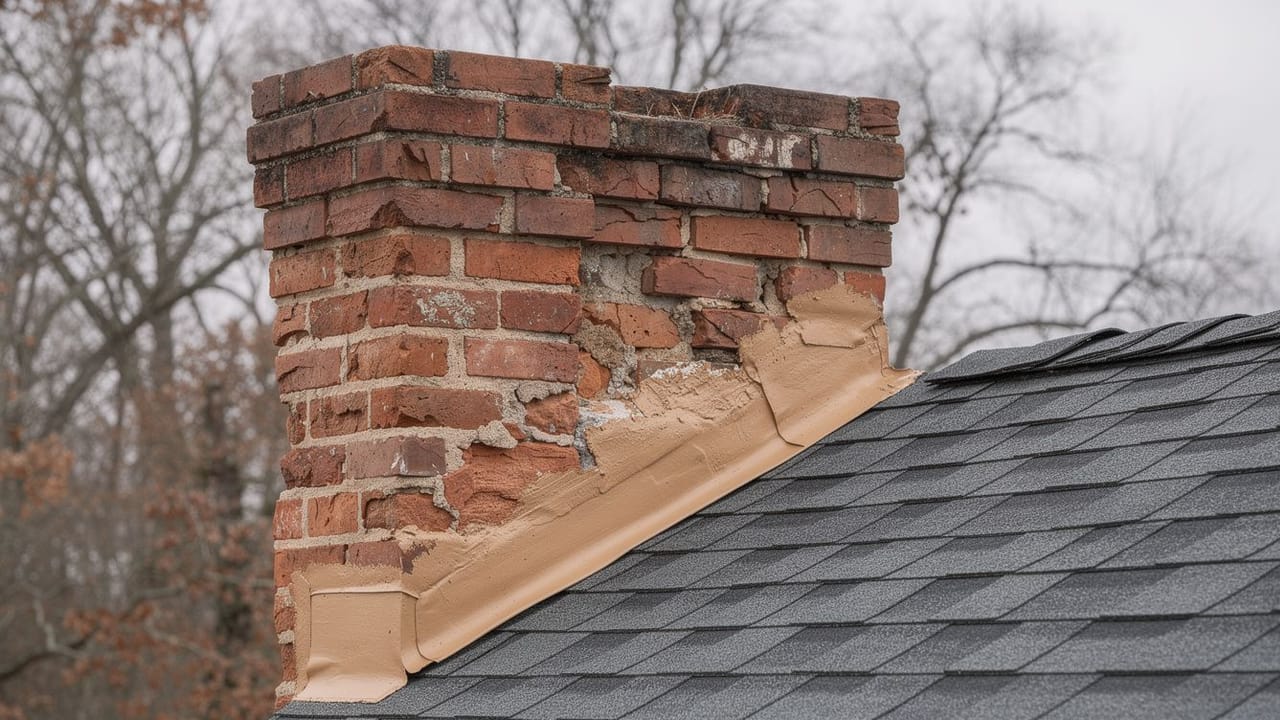
Most calls about chimney masonry start the same way: sand on the shingles below the stack, a joint you can push a key into, or a brick whose face has come off in a sheet. The question behind the call is usually whether the chimney needs to come down. Usually it does not, but the repair has to be the right one, and the wrong one, harder mortar or a coat of sealer over bad joints, can make the next few winters worse than doing nothing. This post covers how to read the brick and mortar on a chimney, what a sound repointing job involves, and where a water repellent does and does not belong. It is the work on our chimney masonry and tuckpointing page, explained in full.
Why the stack wears out before the rest of the house
A chimney is the most exposed brickwork on a house. It stands clear of the roof with weather on all four sides and no eave over it, and it takes wind-driven rain from every direction. The Chimney Safety Institute of America says in its water damage recommendations that water does more damage to masonry chimneys than fire, and that the damage is slow enough to be easy to ignore. The same release compares common brick to a sponge and notes that bad mortar joints, or the wrong mortar or brick, greatly increase how much water the chimney takes on.
Water by itself is only half of it. Middle Tennessee winters swing above and below freezing again and again, and each swing works on brick that is already wet. The National Park Service, in its article on common problems with brick masonry, calls water the most destructive force acting on historic masonry and names freeze-thaw as a cause of cracking. Water gets into a joint, freezes, expands, and opens the joint a little further for the next rain.
The Brick Industry Association puts chimneys in the same group as sills, parapets and copings in its Technical Note 46 on maintaining brick masonry: brickwork with severe exposure that may need repair more often than the walls of the house. So a chimney with tired joints on a house whose walls look fine is not unusual, and it is not a sign the whole house is going.
Reading the brick and the mortar
BIA Technical Note 46 gives a plain checklist for when joints need repointing, and most of it can be judged by eye and by scraping a joint lightly with a metal tool. Any one of the signs in the list below is enough to call for it.
Mortar that comes out in grains under a screwdriver, or a joint you can see daylight into from the side, is past the point where a surface patch will hold. A joint that is sound but stained is not. Brick is read separately. The same technical note says broken bricks and bricks with heavy spalling, where the face has flaked or popped off, let water in and may need to be cut out and replaced rather than patched around. A thin flake on one brick is a warning. A run of bricks with their faces gone, usually on the side of the stack that takes the worst weather, means water has been getting into that area for a long time.
From the ground you can usually see the worst of it with binoculars, but the top courses and the crown are where trouble starts and where it is hardest to see. A chimney inspection puts someone on the roof to look at every face of the stack, the crown and the flashing, and runs a camera down the flue, because water that gets through the outside brick also shows up inside.
- Mortar worn back more than about 1/4 inch from the face of the brick
- Mortar that crumbles when scraped
- Holes or voids in the joints
- Hairline cracks running through the mortar
- Cracks opening between the brick and the mortar
What proper repointing involves, and why the mortar must be softer
Repointing means cutting out the failed mortar and replacing it with new mortar packed into the joint. Per BIA Technical Note 46, the old mortar comes out with a toothing chisel or a pointer’s grinder to a depth of at least twice the joint width, which is generally 3/4 inch, or to sound mortar if that is deeper. A grinder cannot fully clear the short vertical head joints without nicking the brick, so those are finished by hand. The new mortar goes in layers no more than 1/4 inch thick, each left to stiffen before the next, and the joint is tooled when it is thumbprint hard. Because it is hard to tell which joints are leaking, the note advises repointing every joint in the affected area, not just the ones that look worst. Smearing mortar over the face of a worn joint skips every one of those steps and usually falls out within a few winters.
The mortar itself is the part that most often goes wrong. The same note is clear that repointing mortar should be equal to or lower in compressive strength than the original. A mortar that is harder than the brick concentrates the stress of movement and freezing at the edge where brick meets mortar, and the brick face is what gives way. The NPS article makes the same point about high-cement mortars: they are less permeable than the brick around them and can speed up the decay of the masonry next to them. A chimney is meant to have the mortar be the part that wears and gets renewed, not the brick.
In practice that means matching the mortar to the chimney. BIA describes Type N as the usual choice for modern brickwork, Type O where a cement-rich mortar would be too strong, and Type K, the weakest, for some historic work. When nobody knows what the original mortar was, the note points to lab analysis under ASTM C1324. It also says something about who does the work that is worth repeating: an excellent mason may not be qualified for repointing. Laying new brick and repointing old brick are different skills, and a chimney shows the difference in a few winters.
Where a sealer fits, and where it does not
A clear water repellent is often sold as the fix for a leaking chimney. The Brick Industry Association’s Technical Note 6A on colorless coatings says otherwise. A repellent cannot stop water coming through mortar joints that are not completely filled or through a failed cap or coping, it can be futile on a wall with those defects, and it is not recommended in place of repointing and replacing spalled brick. Sealing over bad joints only puts off finding out they are bad.
The type of product matters as much as the timing. The same note says only vapor-permeable repellents, siloxanes and silanes, belong on exterior brick, and that film-forming coatings should not go on brickwork in a freeze-thaw climate. A coating that does not breathe holds water inside the brick, and that trapped water clouds the surface and spalls the face, the same damage the coating was bought to prevent. The note sets a permeability of 0.98 or greater, tested under ASTM E96, for a product that lets the brick dry.
Done in the right order, a repellent can earn its place. BIA names chimneys as severe-exposure brickwork where a breathable repellent can help with small deficiencies that remain after the repairs, and it advises waiting several months after the masonry work to see whether one is needed at all. The order we follow is the repair first, then time, then a decision on the sealer. The crown at the top counts as part of the repair: the CSIA advises a crown that projects two inches past every side of the chimney, and our post on chimney caps explains how the hood above it keeps rain out of the flue, while crown and flashing repair covers the slab itself. If your chimney has sandy joints or flaking brick, ask us for a free estimate and we will look at every face of it before we tell you what it needs.
Sources
- Brick Industry Association, Technical Note 46: Maintenance of Brick Masonry (2017) — When to repoint, how deep to remove mortar, why repointing mortar must be no stronger than the original, mortar types, layering and tooling, replacing spalled brick, and chimneys as severe-exposure brickwork.
- Brick Industry Association, Technical Note 6A: Colorless Coatings for Brick Masonry (2008) — Repellents are not a substitute for repointing; only vapor-permeable siloxanes and silanes on exterior brick; no film-forming coatings in freeze-thaw climates; wait several months after repairs.
- Chimney Safety Institute of America, Four Low-Cost Recommendations to Prevent Major Water Damage (2010) — Water does more damage to masonry chimneys than fire; brick absorbs water like a sponge; crowns should project two inches past each side.
- National Park Service, Common Problems with Brick Masonry — Water as the most destructive force on historic masonry, freeze-thaw cracking, and hard high-cement mortars speeding deterioration of the brick around them.